Meet the Founder
Bogdan Ghica
Founder, BG Performance Consulting

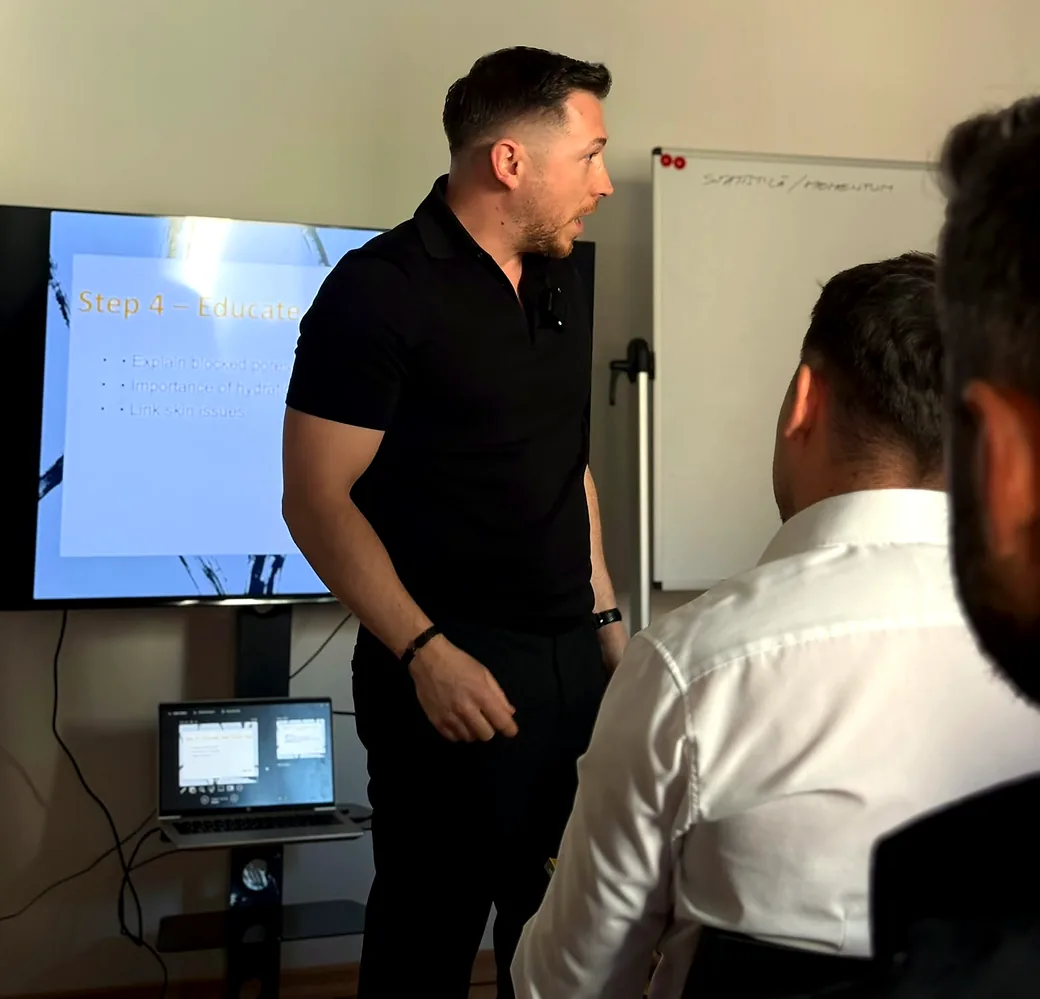
About the founder
Bogdan Ghica
I have spent the last 12 years in sales — first in front of the customer, then developing people, and later leading sales teams and operations.
BG Performance Consulting is the result of that experience and of a conviction built over time:
Performance changes when people change — and when what they are capable of doing becomes consistent.
I Learned Sales by Selling.
My first sales training lasted a few minutes.
I was shown what I needed to do, watched how the others worked for a short time, and then it was time to go in front of the customer.
There was no complex onboarding program. No manual telling me what to do in every situation.
I had to learn.
And, above all, I had to produce results.
I began observing the people around me, testing approaches, understanding what worked and what did not, and constantly asking myself what I could do better.
Over time, the results began to grow.
What followed were roughly seven years working in commission-only sales, in international environments and in places including Vienna, Milan, Olbia, Bergamo, Riga, Luzern and Frankfurt.
When your income depends directly on what you sell, the feedback is very clear.
Knowing is not enough.
Good intentions are not enough.
You have to find a way to turn what you know into a result.
That period taught me one of the principles I continued to work by:
The same actions produce the same results.
If I wanted a different result, I had to be willing to change something.
Sometimes the technique. Sometimes the discipline. Sometimes the way I approached the customer.
And very often, the way I myself looked at the situation I was in.
Those years in sales taught me how to develop my own performance. The next stage would teach me how to develop it in other people.
From My Own Performance to Developing Others.
At some point, my own success in sales stopped being enough.
I became interested in a different question:
Could I help another person achieve better results?
The first person with whom I had the opportunity to truly test that was my wife.
We worked together for around two weeks before she started selling.
I did not only want to explain what to say.
We worked on how she thought about selling, the confidence she brought into the conversation, techniques, real situations and how she responded when things did not go according to plan.
After around two months in sales, she had become one of the company’s top performers.
Then I had the opportunity to train another person from zero.
The result repeated itself.
After the training period and roughly two months of activity, he too had become one of the top salespeople, in an environment where he was working alongside colleagues with years of experience.
For me, that changed something.
It was no longer only about my own ability to sell.
I was beginning to understand that performance could be developed.
In the years that followed, I trained more than 30 people and became increasingly interested in what separates someone who knows a technique from someone who can use it when it matters.
At the same time, my interest in personal development and human performance led me to books, study and seminars delivered by people such as Bob Proctor and Tony Robbins.
I was not looking for a motivational formula.
I was trying to understand something I was already seeing in sales: why two people with the same tools, the same opportunities and similar knowledge can produce completely different results.
Gradually, the way I developed people began to form around a simple idea.
First, the salesperson’s foundation: mindset, confidence, discipline and responsibility.
On top of it, the right techniques for the industry and the real situations in which they have to sell.
Then practice, feedback and repetition until what the person knows begins to show up in what they do.
Training taught me that I could develop one person’s performance. Leadership would teach me what happens when you have to do the same thing across an entire team.
From Training to Leadership.
When I felt the next step was management, I wanted responsibility for more than my own performance or the development of one person.
I wanted to understand how you build a team that performs.
My first experience was not a success.
I stepped into a management role in Bergamo convinced that my experience in sales and training would be enough.
It was not.
Being able to sell does not automatically mean you know how to lead people.
Being able to train a salesperson does not mean you already know how to build a team.
I had to learn again.
How to give direction. How to set standards. How to manage different people. How to recruit. How to create accountability without leading only through pressure. How to understand what sits behind a weak result before simply asking for a better one.
And, perhaps most importantly, how to build an environment in which performance does not permanently depend on the manager being present.
I also began to understand that people need more than a target.
A salesperson may know what to do and have the tools to do it. But if they do not understand where the company is going, what it is trying to build and why their contribution matters in that journey, their relationship with work remains largely transactional.
And when pressure, rejection or difficult periods arrive, a target alone is not always enough to keep them connected.
I began to see leadership as a responsibility for alignment as well: creating the link between the company’s vision, the team’s objectives and what each person does every day.
I did not give up on leadership after the first failure.
I continued preparing for the next opportunity.
And that opportunity came in Frankfurt.
From €30K to Approximately €250K per Month.
When I took on management responsibilities in Frankfurt, the operation had one location, three people and generated approximately €30K in monthly sales.
Over the following 12 months, we grew to two locations, 25 employees and approximately €250K in monthly sales.
But the final number tells only part of the story.
Behind it were people.
Recruitment. Training. Direct selling. Coaching. Interviews. Leadership. Organization. Logistics. Standards.
And the building of a culture in which people understood what we were trying to build something together.
An important part of my role was turning the company’s direction into something relevant to the people in the team — connecting the organization’s objectives with their own, clarifying the standards we wanted to build, and helping each person understand their role in the growth of the operation.
Because I saw a difference between someone who comes to work to hit a target and someone who understands what the team they belong to is building and where they contribute to that journey.
The first can execute.
The second also has a reason to keep executing when things become difficult.
For me, culture is not what a company writes on a wall. It is what people come to believe, accept and do together, day after day.
I was directly involved across all of these areas.
That experience showed me that a team does not grow because you found one good sales technique.
Nor because you delivered one good training session.
Performance appears when the right people are developed, when what they learn reaches their behavior, when leaders know how to lead those behaviors, when standards are reinforced consistently enough to become part of the normal way of working, and when people understand where the company is going and their role in that journey.
That is where I began to see the complete picture.
From the mindset of a single salesperson to the performance of an entire operation.
And it was there that one of the principles behind BG Performance Consulting became firmly established:
Results change when what people do to produce them changes.
After three years in management, the question for me was no longer what the next role would be.
It was:
How can I use everything I have learned to help more people and more organizations?
Why I Created BG Performance Consulting.
Looking back, the most important moments in my career are not only the ones in which I sold the most.
They are also the moments when I saw someone I had trained begin to believe they could do it.
A salesperson who used to avoid a difficult conversation and, over time, began to lead it.
A new person who came to perform alongside colleagues with years of experience.
A leader who began to look beyond the number and understand the people behind it more clearly.
A team that began to understand not only what it had to do, but what it was building together.
A team that began to operate at a standard it had not previously considered possible.
I realized that my satisfaction does not come only from my own performance.
It comes from seeing what happens when a person discovers and begins to use more of their own potential.
That is where BG Performance Consulting came from.
Not to add another training session to a company calendar.
And not to arrive from the outside with a set of recommendations that look good in a presentation.
But to work directly with salespeople, leaders and management, understand what is holding them back and build the change together that can produce better performance.
Sometimes the problem is mindset.
Sometimes the person knows exactly what to do but cannot execute consistently.
Sometimes the constraint is leadership.
In other situations, the company’s direction does not reach the people who have to turn it into action clearly enough. Management knows where it wants to go, but the people in the field do not always see the link between that vision and what they do every day.
And that is precisely the link we work on.
That is why I do not start with a program.
I start with the people.
With the reality of the team.
With what happens when the customer is in front of them.
With what leaders observe, develop and accept.
And with the gap between the performance the team produces today and the performance it could be capable of producing.
For me, this is the next chapter of a journey that began in front of a customer, with very little preparation and a great deal to learn.
Today I can use what I have learned to help others develop.
That is why BG Performance Consulting exists.
The Principles Behind My Work.
My experience in sales, training and leadership has changed how I think about performance over time.
Today, five principles sit at the foundation of how I work with people and teams.
-
01 — Performance Starts in the Person’s Mind.
How someone interprets objectives, pressure, rejection and circumstances influences what they do within them.
Mindset does not produce the result on its own.
But it influences the behavior of the person who has to produce it.
-
02 — What We Know Has to Reach Behavior.
Knowing a technique and being able to use it consistently are two different things.
Training becomes valuable when what a person understands begins to show up in customer conversations and in how they work day after day.
In sales, what we know does not produce results. What we do with what we know does.
-
03 — Leadership Creates the Environment in Which People Perform.
A leader cannot control a person’s mindset.
But they can influence the standards, direction, feedback, accountability and behaviors that become normal within a team.
Leadership cannot control a person’s mindset. But it can create the environment that shapes it, supports it or limits it.
-
04 — People Need to Understand What They Are Building Together.
A vision can be very clear to management and almost invisible to the people who have to turn it into action.
When people understand the company’s direction, the standards it wants to build and the role of their own contribution, their work gains a context larger than the next target.
Alignment does not mean everyone thinks the same way. It means they understand where the organization is going and how they contribute to that journey.
-
05 — Change Has to Be Implemented, Not Just Recommended.
A training session is not the result.
A strategy is not the result.
A recommendation does not create value simply because it is correct.
Value appears when change reaches what people do and can be observed in their behavior and performance.
That is why I do not only want to recommend what should change.
I want to work alongside the team until the change begins to show.
I do not believe a team always needs more training.
And I do not believe management needs to know exactly what the problem is before we begin a conversation.
Sometimes the first step is simply to look more closely at what is happening.
At the people. At the behaviors. At leadership. At the results. And at the gaps between them.
If you want to understand where your team is today and what could help it move forward, we can start there.
Tell Me About Your Team.
You do not need to know exactly what the problem is or which service you need. Tell me where your team is today, which results you want to improve and what you feel is holding it back. From there, we can begin to understand where the constraint sits.